
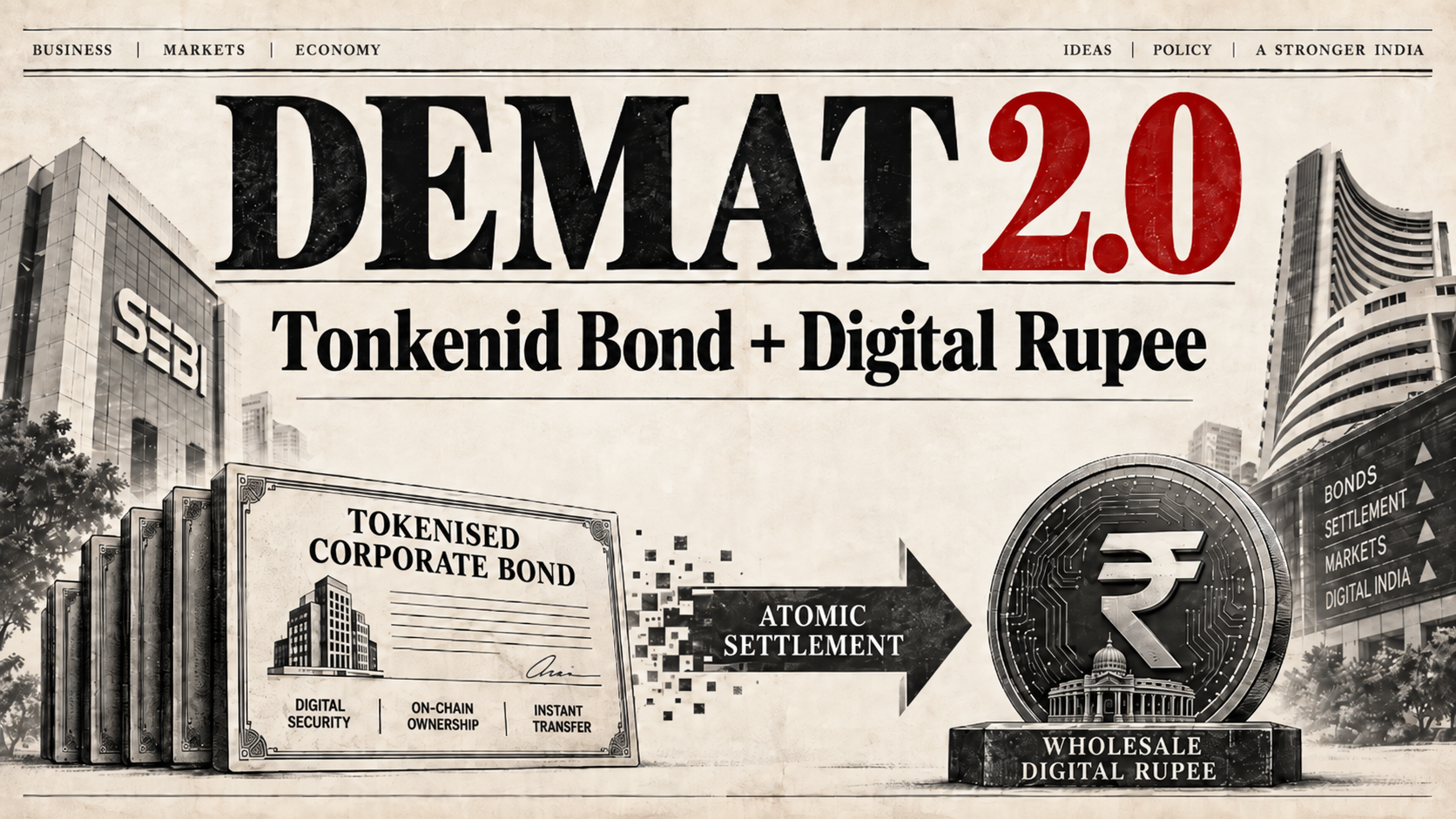
India just flipped a switch on a new version of its demat ecosystem Demat 2.0 where currently corporate bonds are issued as digital tokens and settled instantly using the RBI’s wholesale digital rupee. Announced at the Global Fintech Fest 2026 by RBI Governor Sanjay Malhotra and SEBI Chairman Tuhin Kanta Pandey, the pilot is less about hype and more about efficient and secured financial ecosystem: it tests whether tokenisation plus central bank digital currency (CBDC) can make bond markets faster, safer, and easier to scale.
In practice, Demat 2.0 means an issuer can create bond as tokens on a private distributed ledger, investors can subscribe in the primary market, and on allocation the bond tokens and the digital rupee change hands at the same instant. That is called “atomic” settlement either both legs complete or neither does, this removes the classic gap between paying money and receiving securities, cutting settlement risk and failed trades.
The first live run already proved the concept: issuers like REC, L&T, and IIFL raised around ₹1,025 crore via tokenised bonds settled in wholesale e₹. Currently, access is institutional and focused on primary issuance; secondary trading and retail participation are expected in later phases as the framework matures.
What actually changes?
This changes nothing for the user, the user uses his/her existing infrastructure and everything happens in the background. The only change is that your existing demat account getting two linked “wallets” under the hood:
A securities wallet that holds bond tokens recorded on a distributed ledger.
A currency wallet that holds wholesale CBDC (digital rupee) for settlement.
When a new bond is allotted, the system credits your securities wallet with bond tokens and debits your currency wallet with e₹ simultaneously. Interest (coupon) and principal redemption can be automated through smart contracts, so cash flows arrive on schedule with fewer manual steps and fewer points of failure.
Legally, nothing mysterious happens, the tokenised bond keeps the same ISIN, coupon, maturity, covenants, rating, and investor rights as a conventional bond. The upgrade is in the recordkeeping and settlement layer, not in the contract itself.
Demat 2.0 uses “Distributed Ledger” & not “Blockchain”!
In this whole discussion you would have heard a word called Distributed Ledger/Distributed Ledger technology (“DLT”) and you may feel that it is same as Blockchain. The one line difference between DLT & Blockchain is that Blockchain is derived from DLT.
Generally, “DLT” and “blockchain” are used interchangeably, but they aren’t identical. Here’s the simple distinction that matters for Demat 2.0.
Distributed Ledger Technology (DLT) is the umbrella term for any system where multiple participants share and synchronise a ledger without relying on a single central database. The ledger can be structured in different ways, and the network can be permissioned (only approved nodes can validate) or permissionless (open to anyone).
Blockchain is a specific type of DLT where transactions are grouped into blocks, each block is cryptographically linked to the previous one, and the chain grows in a strict sequence. Public blockchains like Bitcoin and Ethereum are permissionless and typically rely on energy intensive or stake based consensus.
Key practical differences:
Structure: All blockchains are distributed ledgers, but not all distributed ledgers use a chain of blocks structure; some use other data designs.
Consensus: Blockchains often depend on proof of work or proof of stake mechanisms; DLT systems can use lighter, faster consensus suited to known, vetted participants.
Access: Public blockchains are open; Demat 2.0 runs on a private, permissioned DLT operated by India’s depositories (NSDL and CDSL), where every node is identified and authorised.
Tokens and sequence: Many public blockchains require native tokens and enforce a strict block sequence; permissioned DLTs used in finance can drop the token requirement for consensus and optimise for scalability and control.
Why does this matter for Demat 2.0? Because regulators want the benefits of a shared, tamper evident ledger—transparency, auditability, atomic settlement—without the volatility, openness, and performance constraints of public blockchains. A permissioned DLT lets SEBI, RBI, and depositories enforce identity, compliance, and governance at the protocol level while still gaining Realtime, synchronized records across institutions.
A handy way to remember it: DLT is the category; blockchain is one flavour of that category. Demat 2.0 chooses the flavour that fits a regulated securities market.
How DEMAT 2.0 benefits/compliments the securities market ecosystem?
For issuer of bonds/securities nothing changes but it additionally provides the following:
Faster finality: Token creation plus atomic settlement compresses the issuance timeline from days toward near realtime.
Lower operational friction: Automated coupons and redemptions reduce manual reconciliation and payment failures.
Cleaner audits: A shared ledger gives regulators, trustees, and investors a single source of truth for ownership and cash flows.
Investors & especially institutions as of today enjoy the following features:
Settlement certainty: With atomic delivery versus payment, there’s no “I paid but didn’t receive” window.
Reduced counterparty risk: The time gap between the securities leg and funds leg disappears.
Predictable cash flows: Smart contract driven interest and maturity payouts simplify treasury management.
Retail investors are not missed out but rather are kept out of this deliberately for a more matured systems, once the systems are matured the future is promising with broader access to high-quality corporate bonds & securities, potentially smaller ticket sizes via future fractionalisation designs, and a smoother digital experience once the framework opens up beyond institutions.
We can expect more issuers and larger volumes, then secondary market trading of tokenised bonds on existing platforms, and eventually retail onboarding with appropriate safeguards. Success here could pave the way for extending the same architecture to other instruments and, over time, even equity like products moving India toward a genuinely realtime securities market.
For now, it shows that tokenised bonds plus wholesale digital rupee can settle instantly, safely, and at scale using a permissioned distributed ledger that keeps control where regulators need it and speed where markets want it.
FAQs on Demat 2.0: Pilot for Tokenised Corporate Bonds
1. What is Demat 2.0?
Demat 2.0 is a pilot being undertaken by SEBI to explore the next-generation financial market infrastructure. It tests the issuance, holding, trading and settlement of corporate bonds in tokenised form using Distributed Ledger Technology (DLT).
The pilot is the next step in dematerialisation. Instead of recording ownership through a conventional database architecture, the corporate bond is issued as a native digital token on a private, permissioned DLT network owned by the Depositories. The token is the corporate bond.
The pilot does not change the legal character, rights, obligations or regulatory treatment of the corporate bond. What changes is only the technology. Ownership recording, transfer of securities and settlement of the funds leg now take place on a Distributed Ledger Technology (DLT) platform.
2. Is a tokenised bond a new type of security or asset class?
No. A tokenised corporate bond remains a security under the Securities Contracts (Regulation) Act, 1956 and continues to be governed by the applicable SEBI regulatory framework.
It retains the same ISIN, issuer obligations, coupon, maturity, covenants, rating, security and investor rights as a conventional dematerialised bond.Tokenisation changes the technology used to maintain the ownership record; it does not create a new asset class.
3. What exactly is being tokenised?
The corporate bond itself is issued as a digital token on DLT infrastructure. The token bears the same ISIN as the corresponding bond issue.
The bond's key terms – such as coupon rate, payment dates, day-count convention and redemption terms – are encoded into the token through a smart contract.
4. How is the tokenised bond issued?
The issuer will continue to use the existing Electronic Bidding Platform (EBP) of stock exchanges for issuance. The ISIN is obtained from the depositories in the usual manner but is flagged as a pilot/tokenised ISIN.
Bidding, bid modification, cancellation and allotment timelines remain as they are today. On allotment the depository credits the securities directly to the Demat 2.0 accounts (a Demat 2.0 account is an extension of the investor's existing demat account and is not a separate demat account) of the allottees. Issue proceeds are received by the issuer in its CBDC wallet.
5. Does the issuer need a Demat 2.0 account?
No. The issuer does not require a Demat 2.0 account. Following allotment, the tokenised corporate bonds are credited directly to the Demat 2.0 accounts of the allottees (within their existing demat account). The issuer does, however, need a CBDC wallet linked to its designated bank account to receive issue proceeds and, where applicable, make coupon and redemption payments.
6. Does an investor need a new demat account or fresh KYC?
No. The Demat 2.0 account is an extension of the investor's existing demat account and is not a separate demat account.
The investor's existing KYC is used. Registration takes place through the existing depository interface by linking the eligible demat account with the CBDC wallet and providing the required consent. The tokenised holding will continue to be visible through the depository's existing interface and holding statement.
7. Who holds the private keys of the Demat 2.0 account?
The depositories will hold and manage the private keys on behalf of investors.
Therefore, investors do not need to independently manage cryptographic keys or acquire specialised DLT infrastructure. From the investor's perspective, the holding continues to be managed through the existing depository interface.
8. What accounts and wallets are required to participate?
Two arrangements are involved:
● Demat 2.0 account: linked to the investor's existing demat account and managed through the depository.
● CBDC wallet: opened with the participant's own bank under the RBI's e₹ pilot.
No separate technology infrastructure or investment is envisaged for the issuer or investor.
9. Why is CBDC being used for settlement?
CBDC provides digital money (e₹) for the funds leg of the transaction.
The securities and CBDC legs are linked through the DLT infrastructure so that they settle atomically either both legs settle or neither does. This eliminates the risk of one party delivering securities without receiving the corresponding payment, or vice versa.
10. What is atomic Delivery versus Payment (DvP)?
Atomic DvP means that the transfer of the bond and transfer of funds occur as a single linked transaction.
If the securities transfer succeeds, the CBDC payment succeeds; if one leg fails, the other leg does not settle either. This removes the conventional interval between trade and settlement, and with it the counterparty exposure that arises in that interval.
11. Will secondary trading happen on a new tokenised exchange?
No. The pilot does not propose a separate trading venue or segregated market segment.
Existing RFQ platforms and OTC reporting platforms of stock exchanges will be linked to the DLT infrastructure. Price discovery, order handling and reporting arrangements will continue through existing channels, while the securities and funds settlement legs are integrated with the tokenised infrastructure.
12. How will coupon, redemption and other corporate actions work?
The terms of the bond are encoded in the smart contract. Coupon, redemption and other scheduled corporate actions can therefore be executed automatically based on the holdings recorded on the ledger on the relevant record date.
The objective is to reduce the need for repeated manual instructions and reconciliation between institutions for each corporate action.
13. Will existing regulatory requirements for the bond change?
No. The pilot is technology-neutral and does not dilute the existing regulatory framework.
Requirements relating to credit rating, debenture trustees, listing, disclosure, investment eligibility, valuation, classification, investor protection and applicable SEBI regulations continue to apply. However, some instances where exceptions are required, it is already accommodated under SEBI regulatory sandbox through
application made by Market Infrastructure Intermediaries.
14. Does tokenisation require a separate credit rating?
No. There is no separate rating requirement merely because the bond is tokenised.
The rating continues to address the credit risk of the issuer and its obligations. Since tokenisation does not alter the issuer's obligation or the bond's cash flows, the existing rating framework applies.
15. Does tokenisation change investment eligibility for institutions?
No. Investment eligibility is determined by the characteristics of the security such as its status as a security, listing, rating, issuer and dematerialised form not by the underlying database technology.
Therefore, where the conventional dematerialised bond qualifies as a permissible investment, the corresponding tokenised bond under the pilot would equally qualify, subject to the applicable rules.
16. Who remains the authoritative record keeper?
The depository remains the authoritative record of beneficial ownership.
The DLT ledger is the form in which the record is maintained for purposes of the pilot it does not displace the depository's statutory role under the Depositories Act, 1996.
17. What happens if a demat account or security needs to be frozen or attached?
Existing regulatory and legal controls continue to apply.
A freeze, attachment or direction applicable to the demat account or the relevant ISIN/token holding will apply to the linked tokenised holding as well.
18. Does participation require investment in new technology?
No. The pilot does not require investment in specialised technology, hardware, connectivity or blockchain infrastructure by issuers or investors.
The Demat 2.0 account operates through the depository infrastructure, while the CBDC wallet is provided through the participant's existing bank.
19. What happens if an investor wants to sell before secondary-market trading
is enabled?
The pilot specifically provides an interim exit mechanism.
During the period before secondary-market trading is enabled, a peer to peer/demat to demat transfer may be enabled on request through Depositories. The payment leg may be completed outside the atomic settlement architecture through CBDC or banking channels. Thus, the investor is not intended to be locked into the investment during the interim period.
20. Who will operate the DLT infrastructure?
The infrastructure is being developed and operated by the Market InfrastructureInstitutions (MIIs), with technology and implementation support from NPCI.
The distributed ledger is private and permissioned. Initially, nodes will be operated bythe depositories and stock exchanges, with the possibility of extending controlledaccess to other regulated entities as the pilot progresses.
21. What are the key objectives of the pilot?
The pilot is intended to test, among other things:
issuance and holding of native tokenised corporate bonds;
integration with existing EBP, RFQ and OTC infrastructure;
atomic DvP using CBDC;
smart-contract-based servicing and exception handling;
regulatory controls and restrictions;
cyber security, scalability, resilience and auditability; and
implications for clearing, settlement finality and the roles of MIIs.
22. What is the proposed rollout of the pilot?
The pilot is proposed to be rolled out in three stages:
Stage I: Tokenised corporate bond issuance through EBP integration, with asset servicing on the ledger; participation initially expected to be institutional.
Stage II: Enablement of secondary-market trading, with access extended to retail participants. An interim P2P/demat-to-demat transfer mechanism may operate before this stage for liquidity.
Stage III: Potential extension of nodes to CRAs, depository participants and other regulated entities, along with consideration of other instruments and a wider range of corporate actions.
23. What is the regulatory basis for the pilot?
The pilot is being conducted under SEBI's Regulatory Sandbox. Any specific relaxation required for the pilot would be provided within the sandbox framework andfor a defined scope and period.
The pilot is therefore intended to test the architecture and operational arrangements before a broader regulatory framework is considered.
24. What are the main expected benefits of Demat 2.0?
The pilot is intended to examine whether tokenisation can provide:
near-instant/atomic settlement, reducing settlement-related counterparty exposure;
automated asset servicing through smart contracts;
reduced operational intervention and reconciliation;
improved auditability and traceability of transactions;
controlled confidentiality through a permissioned network;
greater integration between securities and central-bank-money settlement; and a potentially more efficient securities-market infrastructure without creating a separate trading market.
Key official references:
Demat 2.0: SEBI’s Notification link.
If this story helped you understand the “What is Demat 2.0”, share it with your friends, family, colleagues or even strangers on WhatsApp, LinkedIn or X, and help spread the knowledge.
Also, if you’re someone who is looking for a trusted long-term Equity Advisory, hit the contact us button our NISM Certified Wealth advisor will get in touch with you and discuss your Investment needs (We assure this is spam free). Click here to verify our SEBI Certificate and you can also verify it by searching Finspurt Analytics Private Limited on the following SEBI Website - Click here.