
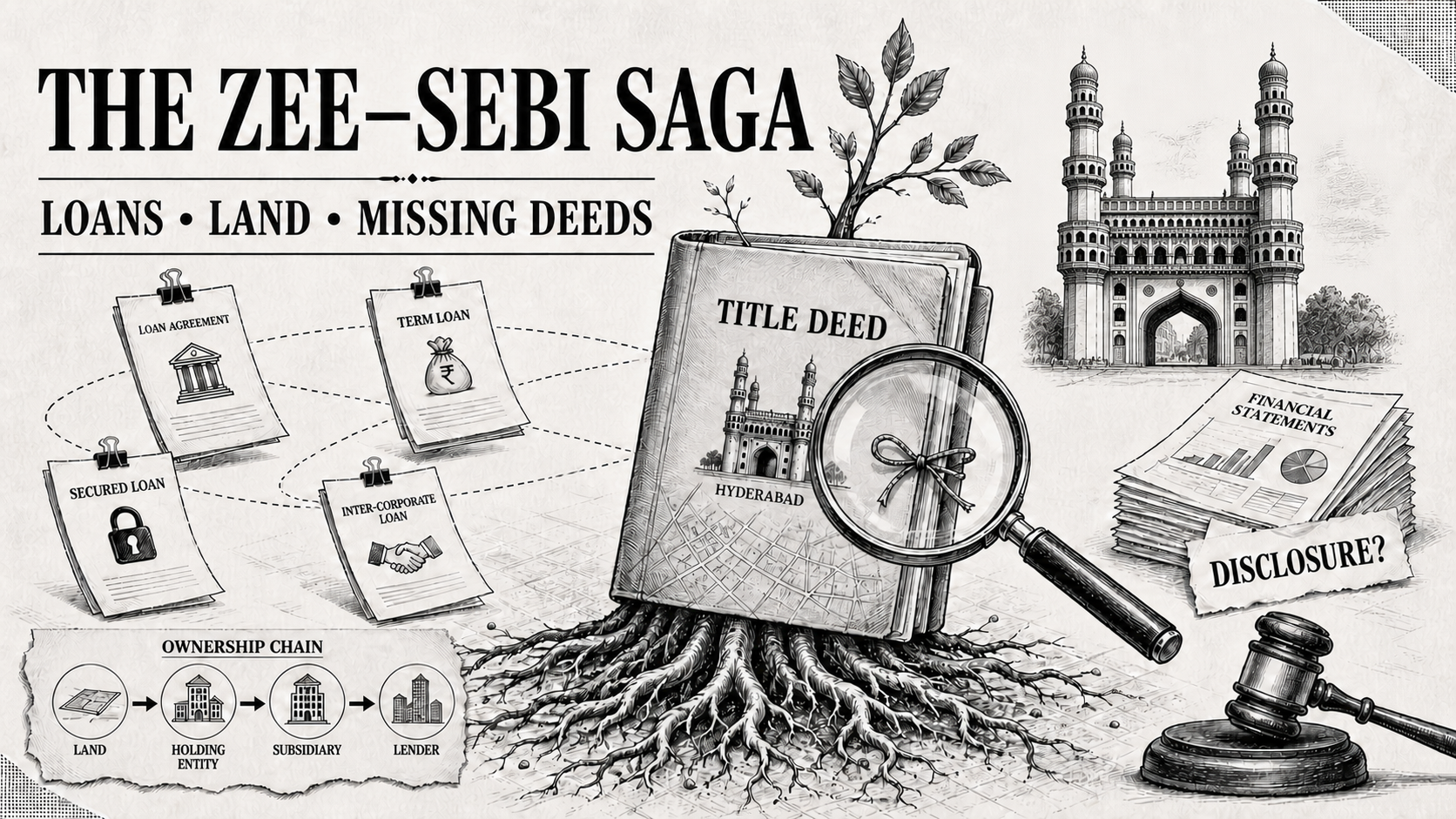
A WIN SO PERFECTLY TIMED, LIFE HAD TO BALANCE IT WITH A PLOT TWIST
ZEE Entertainment Limited (“ZEE or ZEEL”) has faced the exact Situation this July 31, 2026, the shareholders of Zee in an Extra Ordinary General Meeting have approved a fund raiser of 3000 Crores (approx.) (“the exact relief the company was looking for”) by issuing convertible warrants to a Mauritius based entity linked to Goenka’s in the morning and later the same day SEBI has penalised ZEE and its founder and chairman Mr. Subhash Chandra and his son, Former MD & Chairman of ZEE Mr. Punit Goenka under SEBI (Prohibition of Fraudulent and Unfair Trade Practices relating to Securities Market) Regulations, 2003.
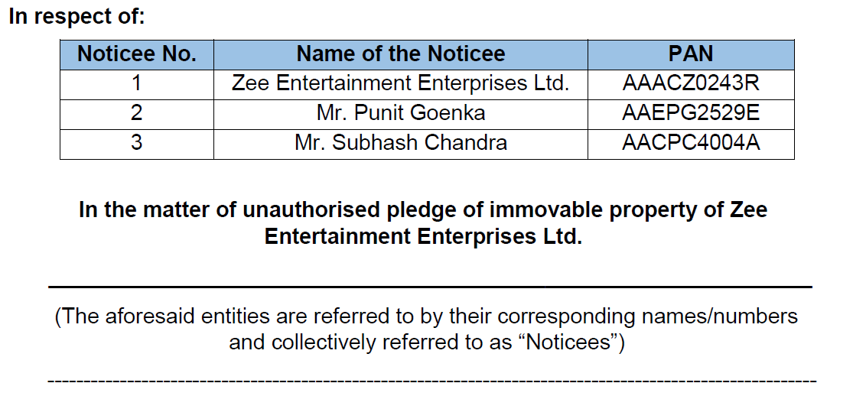
Source: SEBI Order
The Origins of the Case/Order:
SEBI in an ongoing Investigation involving ZEE and Yes Bank (a case related to ZEE’s fixed deposit appropriation of ₹200 Crores by Yes Bank to settle loans of Essel Group Companies) observed an Auditor’s comment in Audit Report pertaining to 2019 that ZEE is not having the title deeds of the land it owns in Hyderabad (“Hyderabad Land or Hyderabad Property or Property”).
This investigation back tracked the title deed to Indiabulls Housing Finance Limited (“IHFL”).
IHFL & ZEE relation: The Core compliance Mishap by the parties to the Case:
In 2016 IHFL lent a combined amount of ₹726 Crores to 4 Entities connected to ESSEL Group, by late 2018 IHFL needed additional security against the loan and Mr. Subhash Chandra signed a Declaration & Acknowledgement (“D&A”) on ZEE’s behalf and handed over the original title deeds to IHFL as first-ranking mortgage over the Hyderabad land/property.
This D&A shared by Mr. Subhash Chandra was neither approved by the Board, Audit Committee of ZEEL nor was publicly disclosed on the exchanges as per SEBI LODR Guidelines.
Connection between the Four entities, ZEE, Punit Goenka & Subhash Chandra and Hyderabad Land:
The four borrowers were Gnex Projects, Vivek Infracon, Gnex Infrabuild, and Renu Realtech.
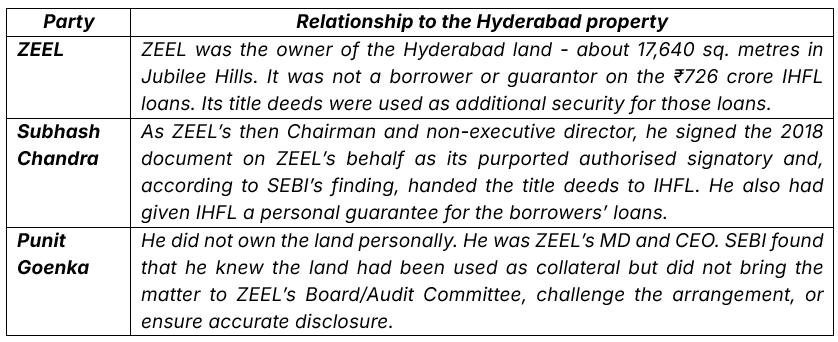
The key link is that SEBI found the land belonged to ZEEL but was used to secure loans of Essel Group borrower entities whose ultimate beneficiaries included Goenka, Chandra, and their family interests.
The title deeds were with IHFL from 27 December 2018 to 1 June 2020. After IHFL received ₹225 crore, it released the deeds, ending the mortgage-related exposure.
According to SEBI’s finding, Subhash Chandra’s & Punit Goenka’s connection was not a direct shareholding in the four borrower companies. It was an indirect control/beneficial-interest chain through the Essel Group structure mentioned below:
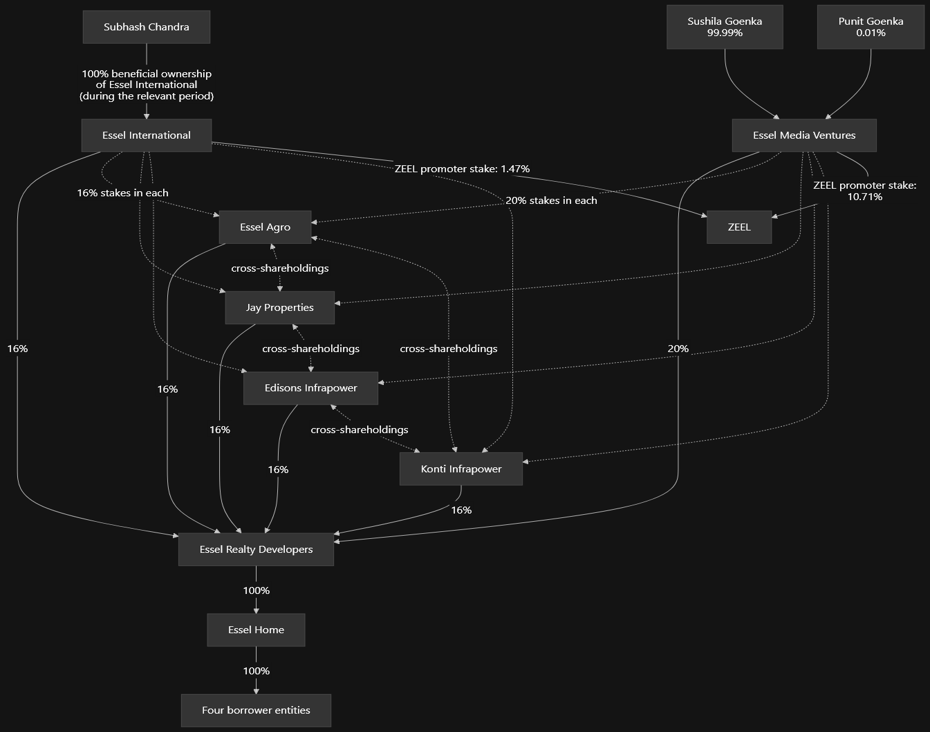
AI- Generated Image: The solid arrows show the main ownership chain. The dotted arrows show why SEBI called the four-company block “circular”.
The entities held stakes in one another rather than acting as independent shareholders, SEBI concluded that ultimate voting influence over Essel Realty flowed back to Subhash Chandra, Sushila Goenka, and Punit Goenka; Punit disputed this conclusion.
SEBI’s reasoning was:
Essel Home wholly owned the four borrower entities.
Essel Realty wholly owned Essel Home.
Essel Media Ventures held 20% in Essel Realty and was, according to the order, owned 99.99% by Mrs Sushila Goenka and 0.01% by Punit Goenka.
Four other companies held a combined 64% of Essel Realty. However, SEBI found these companies were not independent shareholders: they had circular cross-shareholdings involving Essel Realty, Essel Media Ventures, Essel International, and each other.
Therefore, SEBI concluded the real voting and decision-making control of Essel Realty ultimately lay with Subhash Chandra, Mrs Sushila Goenka, and Punit Goenka. Control then flowed down to Essel Home and, finally, the borrowers.
Punit Goenka contested this strongly. He said his indirect economic interest was below 1%, that he had no management or voting rights in the borrowers, and that SEBI had not proved he received any financial benefit. SEBI rejected that defence, reasoning that control could arise from the circular ownership and voting structure, not just from his small direct percentage holding.
So, SEBI’s point was that Punit did not personally own the Hyderabad land or directly owned the borrower companies. It was that he and the promoter family had ultimate influence over the borrower chain that benefited when ZEEL’s land was used as loan security.
Summarised Modus Operandi of the Case:
SEBI’s account is that the arrangement operated like this. This is the regulator’s finding, while Goenka and Chandra disputed key parts of it.
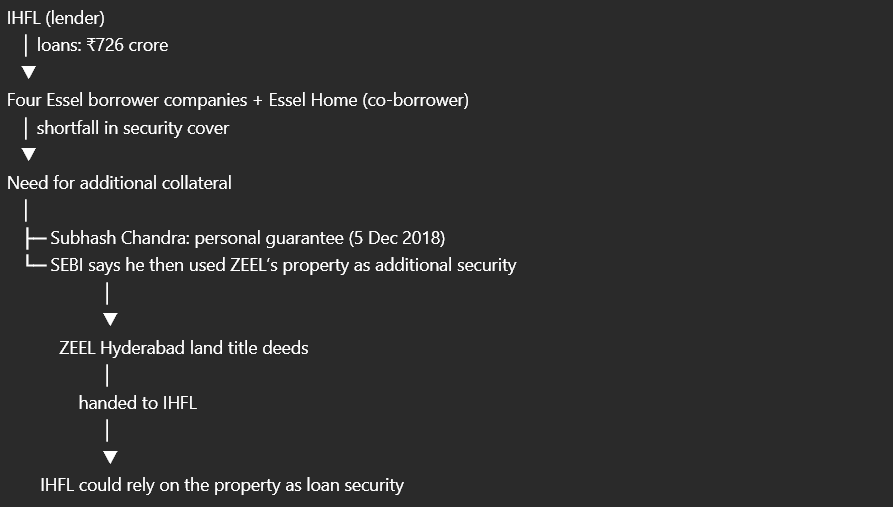
AI- Generated Image:
The whole alleged mechanism, in one line: borrower entities needed more security; IHFL demanded it; Chandra put ZEEL’s land/title deeds forward; Goenka allegedly enabled the arrangement to remain undisclosed; and the borrower group gained protection from lender action while ZEEL bore the property risk.
Penalisation by SEBI on the NOTICEES:
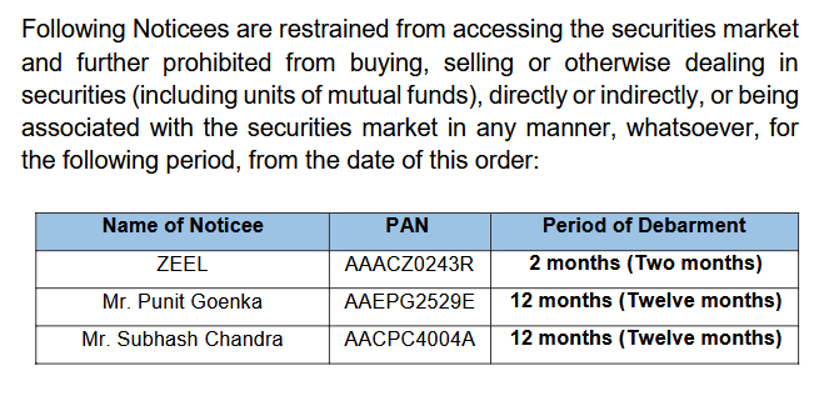
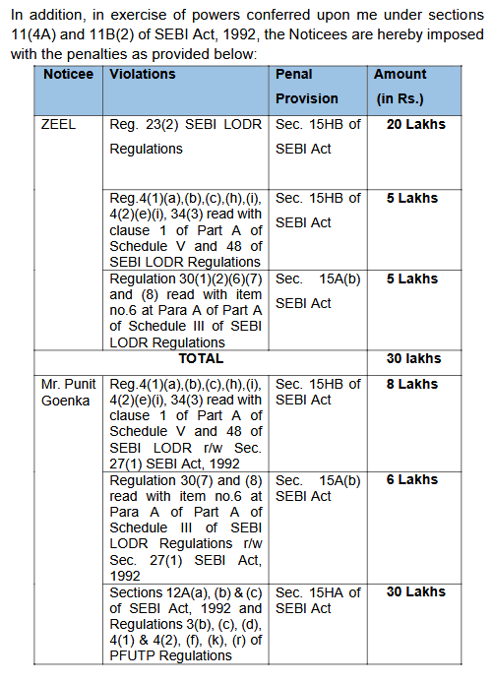
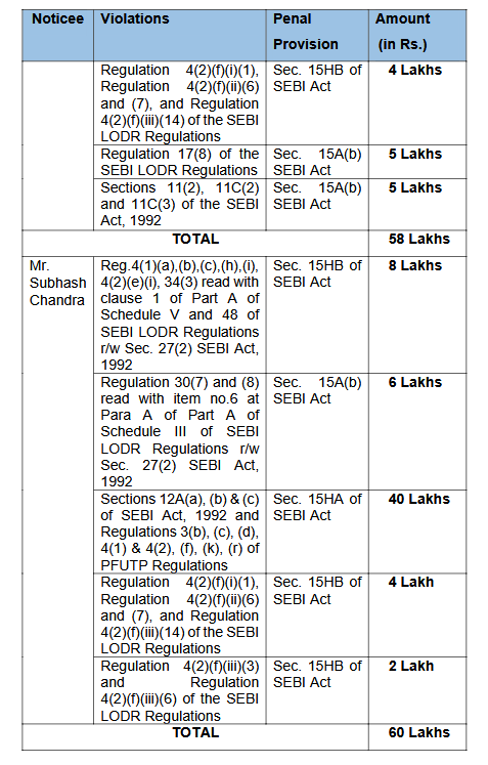
Source: SEBI Order
Conclusion: Why this order is important:
Companies in India Operate on a basic principle of maintaining a distinct difference between Ownership of the company and Management of the company, this distinctions brings the upper management/Directors/Board members to maintain a Fiduciary relation between the functioning of the Company and also balance the Interests of the Investors of the company & this exact trust is what the management of the ZEEL has breached and SEBI got mad about.
This case may not be a big fraud that directly impacts the investor or related parties of the Company rather considering the complexities involved with the ZEE and Goenkas in the recent past, this case highlights how complicated corporate structures and management influence the decisions and course of businesses which may directly or indirectly or positively or negatively impact the Investors and the market ecosystem at large.
Note:
We have tried to summarize the SEBI Order dated July 31, 2026, please click the link below to access the full order for detailed information and understanding.
Final Order in the matter of unauthorised pledge of immovable property of Zee Entertainment Enterprises Ltd.