
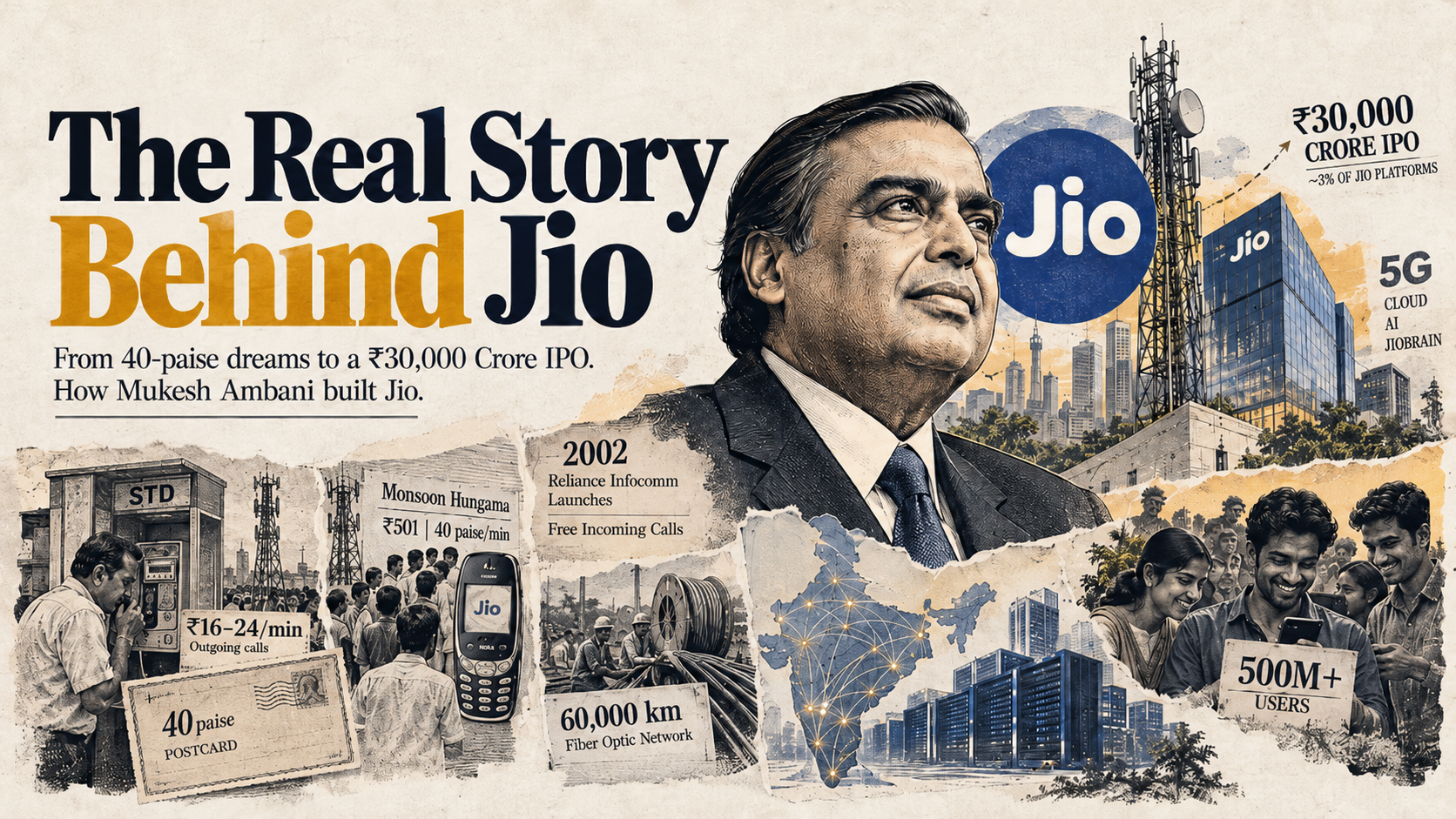
In today’s blog, we talk about the Jio Platforms, which opens for IPO subscription on October 21, 2026, and closes on October 23, 2026. But this time, we’ll look at the story of JIO and how Mukesh Ambani made Jio what it is today.
Also, before we get to the story, here’s a quick note. We are sharing our detailed and simplified analysis of JIO Platforms IPO at the end of this blog for FREE.
Now, onto the story.
This story of Reliance Jio is not merely a tale of corporate rivalry; it is a masterclass in long-term capital deployment, regulatory navigation, disruptive engineering, political controversy and competitive strategy. By examining the rise, banishment, and celebratory return of Mukesh Ambani to the telecom arena, we will see how structural market shifts are identified and exploited to build an empire.
Chapter 1: The Postcard Paradox (Disruption & Consumer Impact Angle)
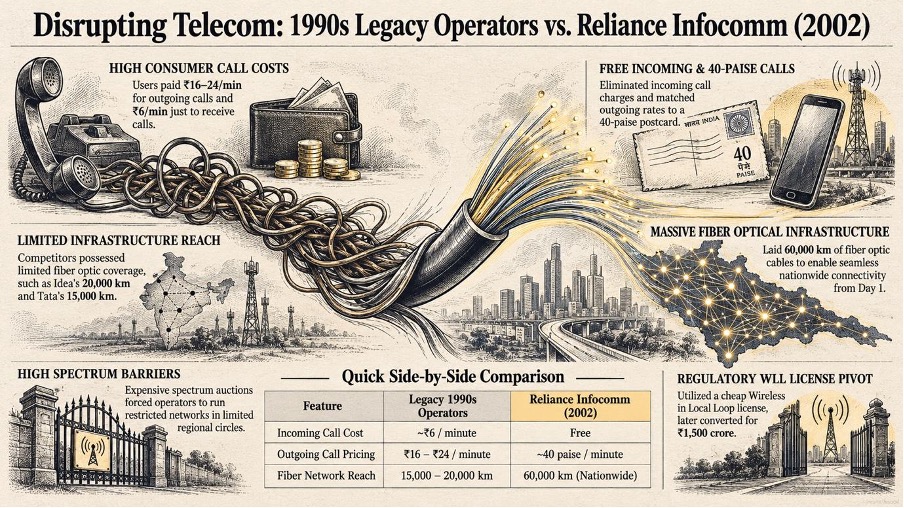
In the late 1990s, Dhirubhai Ambani, saw India as a nation suppressed by the cost of basic communication. India was a land of STD booths, tiny shops with yellow signs where people stood over ticking meters, paying between 4 and 75 rupees per minute depending on distance and time of day.
In 1995 then Telecom Minister Pandit Sukh Ram made India’s first mobile phone call and launched mobile services in India however, the situation remained ugly. Outgoing mobile calls cost anywhere between 16 and 24 rupees per minute, and subscribers were even charged an average of 6 rupees per minute just to receive calls. To survive, ordinary people devised coded missed calls (Millenial’s can relate to this), and mobile phones remained a luxury reserved for the ultra-wealthy.
Alternatively, A postcard was the absolute cheapest way to send a message in India, but it took days to arrive.
And during this time Mr. Dhirubhai Ambani took a bold decision to make cheaper live voice call across India i.e. equal to 40-paise postcard and started the work for building Reliance Infocomm and handed over the same to his son Mr. Mukesh Ambani.
To bypass the exorbitant costs of traditional spectrum auctions, Reliance Infocomm acquired a specific license known as Wireless in Local Loop (WLL1)and Reliance Infocomm launched its mega "Monsoon Hungama2" scheme in 2003, it offered mobile handsets with incredibly cheap call rates using WLL technology. However, through aggressive network routing and a clever digital workaround, Reliance allowed its WLL "fixed-wireless" phones to retain connectivity seamlessly as users moved across cities and states. Effectively, they were providing full mobile services on a cheap, limited-mobility landline license.
The Cellular Operators Association of India (COAI) fiercely protested, accusing Reliance of entering full mobile telephony through the "back door" without paying the steep entry fees that GSM3 operators had weathered. The telecom tribunal (TDSAT) and the government intervened. To resolve the controversy, the government introduced a Unified Access Service License (UASL) system. Reliance Infocomm was forced to pay a massive equalization penalty of ₹485 crore in 2003 to migrate its services legally into a full mobile license, later converting it into a full mobile license for 1,500 crore rupees amid intense political controversy.
During the same time while legacy players like Idea and Tata were laying modest fiber networks of 20,000 km and 15,000 km respectively, Reliance Infocomm ordered the deployment of 60,000 kilometers of fiber optic cable across India. Competitors thought it was crazy to build capacity that far exceeded existing demand, but Reliance was building for the future.
In July 2002 when Mr. Dhirubhai Ambani passed away without leaving a formal will for his family. On December 28, 2002 what would have been his 70th birthday then Reliance Industries started Reliance Infocomm nationwide under the leadership of Mr. Mukesh Ambani. This new business of Mukesh shattered industry norms by making incoming calls 100% free. Six months later Reliance Infocomm introduced the Monsoon Hungama offer: for just 501 rupees up front, a customer received a CDMA-handset4 and 100 rupees of talk time, with subsequent calls priced at exactly 40 paise per minute. Over 10 lakh customers signed up in just 10 days.
Yet, Mukesh’s victory was short-lived. The absence of a formal Will/Sucession planning, a bitter family dispute erupted between Mukesh & his brother Anil. In 2005 their mother, Kokilaben, stepped in, to form a peace treaty. The corporate empire was split. Mukesh retained the legacy cash cows: oil refining, gas, and petrochemicals, while his brother Anil was awarded the high-growth, new-age assets: power, financial services, and telecom creation.
A crucial 10-year non-compete agreement with a single signature legally locked out Mr. Mukesh Ambani from fulfilling his father's telecom dream.
Chapter 2: The Ten-Year Exile and the Turning Point
Mukesh Ambani watched from the sidelines as the telecom sector evolved, while the tension between the brothers continued over gas supply contracts. The initial split agreement dictated that the refining business would supply natural gas to Anil’s power plants at a fixed price well below government-mandated rates. The dispute reached the Supreme Court, and some where in 2010, the court delivered a decisive verdict: Natural Gas Was A National Asset, And The Government Alone Held The Power To Set Its Price. The ruling meant the low-cost agreement was void, sending shares in Anil's flagship company tumbling.
Sixteen days after the court ruling and following a reflective retreat to the Himalayas Anil offered an olive branch. To restore family harmony, he agreed to scrap the 10-year non-compete agreement. The doors opened five years early. Mukesh was free to return to telecommunications.
What happened next was a masterclass in strategic timing.
That very month, the Indian government held an auction for 4G spectrum specifically Broadband Wireless Access (BWA5) licenses. BWA spectrum was an invisible highway through the air reserved for high-speed wireless data, divided into 22 regional circles across India. As auction prices soared into billions of dollars, major legacy operators, including Anil’s company, panicked and withdrew from bidding halfway through.
When the auction results were announced, a small, obscure internet vendor named Infotel7 Broadband owned by the Nahata family emerged as the sole winner of 4G spectrum in all 22 circles. They had spent 13,000 crore rupees on a 50-crore investment base.
Hours after the auction closed, Reliance Industries Limited (“RIL”)(Oil Giant headed by Mukesh) announced it was purchasing 95% of Infotel Broadband for 5,000 crore rupees.
Five years of forced silence. 19 days of ruthless execution. Before competitors could even react to the non-compete being scrapped, Ambani had already seized nationwide 4G dominance.
RIL rebranded Infotel as JIO which, when mirrored, reads OIL a nod to the refining business that funded this ambition. Remember Mukesh announcing JIO and saying DATA is the NEW OIL.
However, there was one major obstacle: BWA spectrum allowed data transmission, but legally prohibited voice calls or phone number allocations. RIL was patient. In 2013, the government introduced a Unified Licensing regime. For an additional 1,650 crore rupees, Jio converted its BWA spectrum into a full-fledged telecom license. The highway was clear.
Chapter 3: Bypassing Legacy and the VoLTE6 Gamble
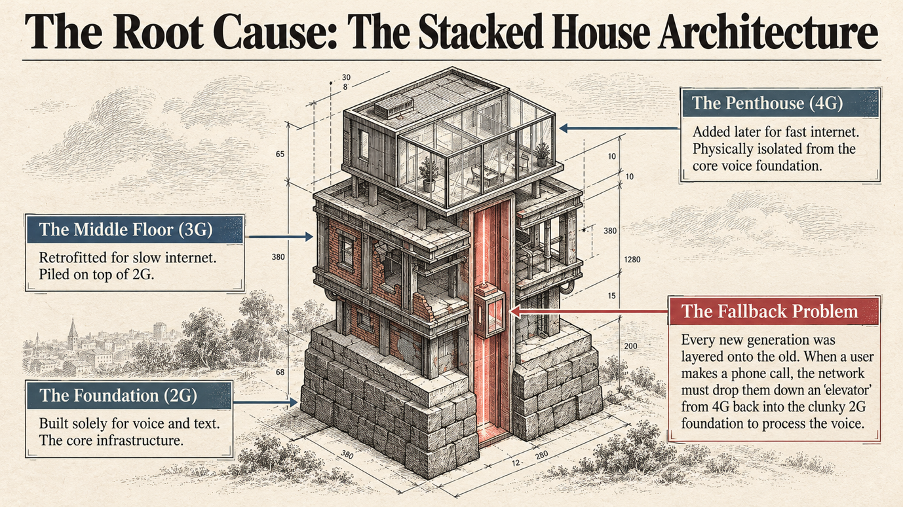
With licenses and spectrum secured across all 22 circles, RIL faced a crucial architectural decision. Legacy operators like Airtel, Vodafone, and Idea had built their networks incrementally over decades. They had a 2G layer for voice calls and SMS, stacked a 3G layer on top for basic internet, and were attempting to graft a 4G layer on top of that for high-speed data. Each layer operated like an additional floor built on an aging foundation. When an Airtel customer made a voice call, their phone had to fall back from 4G to legacy 2G or 3G networks because voice couldn't travel over their initial 4G setup.
RIL had no existing customers and no legacy infrastructure. It had an empty highway & decided to build a completely greenfield, All-IP 4G network from the ground up the first national network of its kind in India.
To see why this was such a breakthrough, think about how phone calls used to happen. On older networks, a call was a bit like booking a private roadline: the system kept a dedicated circuit open just for you, even during those quiet moments. Internet data, on the other hand, is more like parcel delivery: your message is split into little digital bundles called packets, travels alongside other traffic on shared routes, and is put back together in a flash at the other end.
RIL decided to treat voice calls exactly like data packets using a technology called Voice over LTE (VoLTE). Under VoLTE, a voice call is processed identically to a WhatsApp call or an email download. Because voice was converted into efficient data packets riding on a pure 4G network, the marginal cost of carrying a voice call dropped to effectively zero.
This architectural choice meant that legacy operators were trapped. About 72% to 76% of Airtel and Idea’s revenue came directly from voice calls. If they copied JIO’s model, they would destroy three-quarters of their cash flow. If they didn't copy their customers would walk away.
RIL spent between 1.5 and 2 lakh crore rupees constructing towers, laying fiber, and installing IP infrastructure before collecting a single rupee from a single customer. To eliminate onboarding friction, RIL integrated with Aadhaar for instant e-KYC digital verification. Instead of filling out paper forms, submitting photocopies, and waiting days for activation, a new customer could verify their identity via fingerprint and walk out of a store with an active SIM card in under five minutes.
Chapter 4: The Tsunami of Disruption and the Digital Empire
On September 5, 2016, RIL launched Jio to the public. It sent shockwaves through the global market: 100% free high-speed 4G data, free voice calls, and free SMS for everyone for nearly a full year. To solve the problem of older devices lacking native VoLTE support, RIL flooded the market with affordable JioPhone 4G feature phones.
The consumer response was unprecedented in business history:
● 1.6 crore subscribers joined in the first month.
● 5 crore subscribers signed up in 83 days (an average of 7 new subscribers every second).
● 10 crore subscribers were onboarded in just under 180 days.
Legacy operators were helpless. They could not match the zero-price strategy without bankrupting their core operations.
Just imagine the impact: In 2014, 1 GB of data in India cost roughly 269 rupees. By 2017, under Jio, the price dropped to 19 rupees per GB, a reduction of over 90%. Total national internet usage exploded by 46 times. This massive influx of low-cost data laid the digital bedrock for India's booming startup ecosystem, UPI digital payments, video streaming, and gig-economy platforms.
The competitive landscape was devastated. India’s telecom sector collapsed from 16 active operators down to a tight oligopoly. Reliance Communications (Anil's company) filed for bankruptcy, Vodafone and Idea were forced into a desperate merger to survive, and numerous smaller players vanished. Today, Indian telecom is essentially a duopoly between Jio and Airtel.
In 2020, during the global pandemic, Jio capitalized on massive subscriber base by raising 1.5 lakh crore rupees from marquee global investors including Meta, Google, and Qualcomm, making Reliance entirely net debt-free. In 2022, jio committed 88,000 crore rupees in India's 5G spectrum auction, building a dedicated 5G user base of over 28 crore customers within a total subscriber pool of 53 crore.
As Jio prepares for its record-breaking 30,000 crore rupee spin-off IPO in 2026, generating annual profits of nearly 30,000 crore rupees, Universal business principles emerge from this journey:
Strategic Patience & Silent Preparation: Real strategy requires waiting without standing still. Banned by a five-year non-compete agreement, Mukesh Ambani didn't abandon his vision—he prepared in silence. When the barrier fell, Reliance acquired nationwide 4G spectrum in just 19 days. Preparation makes swift execution possible.
Capital Liquidity at Key Inflection Points: Opportunity without cash readiness is useless. While legacy rivals hesitated due to debt and spectrum costs, Reliance possessed the balance sheet strength to deploy over ₹1.5 lakh crore before collecting a single rupee from customers. Having funds ready allows you to capture an entire market when others retreat.
Rejecting Legacy Norms via Root-Cause Innovation: Legacy operators protected call rates because voice generated 75% of their revenue. Bypassing old infrastructure entirely, Ambani built an all-IP 4G network using VoLTE. By converting voice into free data packets, Jio obliterated the competition's core business model overnight.
Decisive Execution Over First-Mover Advantage: Sixteen telecom operators existed long before Jio, yet all focused on short-term call margins. Ambani took the long view—laying 60,000 km of fibre optic cables and pricing for 500 million future digital consumers. Incumbency means nothing without bold execution.
The story of Reliance Jio shows how long-term strategic vision, greenfield technological execution, and decisive capital allocation can completely transform a national economy and dismantle legacy monopolies.
Until Next time, Click on the link below to download the FREE Analysis of the JIO Platforms IPO below.
Here is a super simple breakdown of those seven tricky terms used in this Blog:
1. WLL (Wireless in Local Loop)
Imagine a traditional home landline phone that plugs into the wall with a cord. WLL was like making that home phone wireless so you could carry it around your neighborhood like a walkie-talkie without needing long underground wires.
2. Monsoon Hungama
Think of this as a super-cheap mega-sale that Reliance launched twice to get millions of people onto their network:
· The First Version (2003): You paid just ₹501 to get a brand-new mobile phone and call rates as cheap as sending a paper postcard.
· The Second Version (2017 with Jio): A similar mega-offer selling super-cheap 4G phones packed with free calls and free internet so millions of people could join.
3. GSM
GSM is simply the standard system used by older phone companies (like Airtel and Vodafone) where you insert a tiny plastic SIM card into your phone to connect to nearby towers for calls and text messages.
4. CDMA Handset
Unlike GSM phones that use a removable SIM card, a CDMA handset was a phone where your phone number was programmed directly inside the phone itself. It was much cheaper to build, which allowed Reliance to offer ultra-low call prices.
5. BWA (Broadband Wireless Access)
Think of BWA as a special government permit to send super-fast wireless internet through the air. It gave a company permission to build a giant Wi-Fi network across the whole country (though at first, it was only meant for internet data, not regular phone calls).
6. VoLTE (Voice over LTE / Voice over 4G)
Instead of making phone calls the old-fashioned way, VoLTE turns your voice into tiny internet data packets just like when you make a call on WhatsApp. Because your voice travels as internet data over a 4G network, making calls costs almost nothing and sounds crystal clear.
7. Infotel
Infotel was a small internet company that won the government permit (BWA) for all 22 regions of India. Mukesh Ambani bought Infotel in 2010 and renamed it Jio.
Key official references:
If this story helped you understand the “How Mr. Mukesh Ambani made JIO what it is today”, share it with your friends, family, colleagues or even strangers on WhatsApp, LinkedIn or X, and help spread the knowledge.
Also, if you’re someone who is looking for a trusted long-term Equity Advisory, hit the contact us button our NISM Certified Wealth advisor will get in touch with you and discuss your Investment needs (We assure this is spam free). Click here to verify our SEBI Certificate and you can also verify it by searching Finspurt Analytics Private Limited on the following SEBI Website - Click here.